



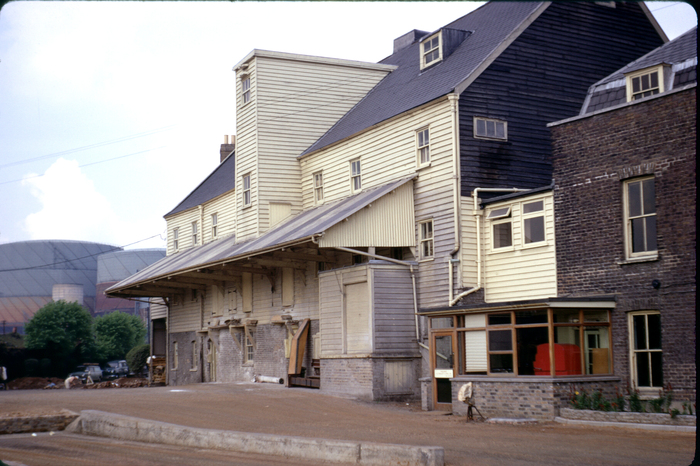
1. There has been a water mill on the River Lea at Ponders End since at least the 16th century and possibly since the 11th century, as a mill is recorded in Enfield in the Doomsday book of 1086. The Grade II listed part weatherboarded Wright’s Flour Mill has sections dating back to 1697. It is Enfield’s oldest working industrial building. The mill was originally powered by water from a mill stream diverted from the river. In 1909 electric power was introduced. In the centre is a projecting sack hoist. Since this photograph was taken by Geoffrey Gillam in 1968, a modern loading bay extension has been constructed at the front. The mill buildings, 18th century miller’s house and water meadows make up the Ponders End conservation area. (see newsletter 180 Winter 2010). [Credit: Enfield Archaeological Society]
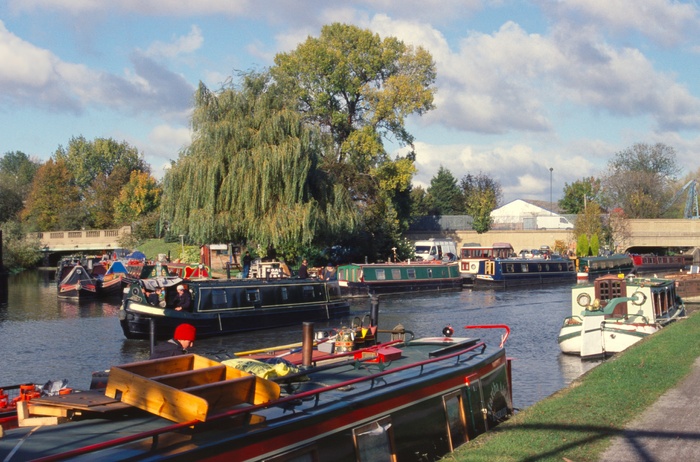
2. The River Lea historically marked the boundary between Hertfordshire and Middlesex to the west and Essex to the east. It flowed south into the River Thames at Bow Creek. In medieval times it was used to transport wheat by barge to watermills on the river. Barley and malt were also taken down the Lea to London breweries. “London manure” (i.e. human waste) and building materials such as locally manufactured bricks and timber, which was also used locally to make furniture, were also transported by barge. From the 12th century various improvements were made to the river. In the 18th and 19th centuries cuts and locks, including Ponders End lock, converted the river into the Lee Navigation. Many of the narrow boats now to be seen are moored at Ponders End. North of here most journeys are now made for pleasure, although even in the 21st century at least one of the narrow boats was offering to transport coal, oil and gas. (see newsletter 208 Winter 2017). [Credit: Stephen Gilburt]
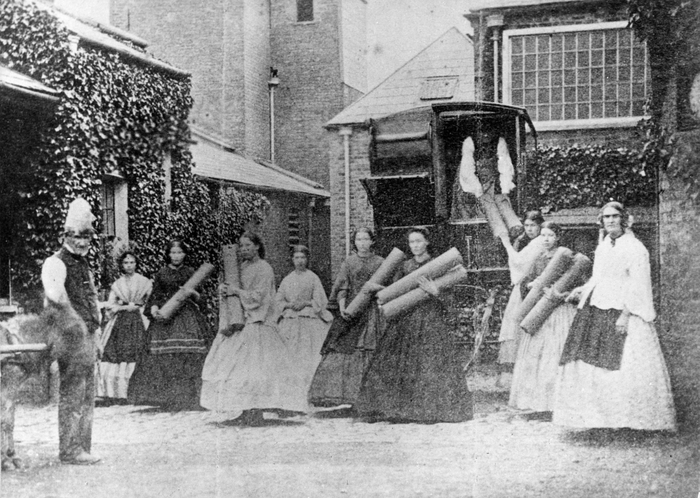
3. In 1809 Grout and Baylis opened a factory for the manufacturing, dyeing and crimping of crape, at the junction of South Street with Scotland Green Road. In the 19th century it was fashionable for people to wear dark coloured crape clothes for long periods of mourning after a death in the family. Some of the up to 200 poorly paid mainly female workers are shown here holding rolls of crape. Their male supervisors were better paid. Children were also employed. However following a change in fashion, demand for crape fell and the factory closed in 1894. [Credit: Enfield Local Studies & Archive]
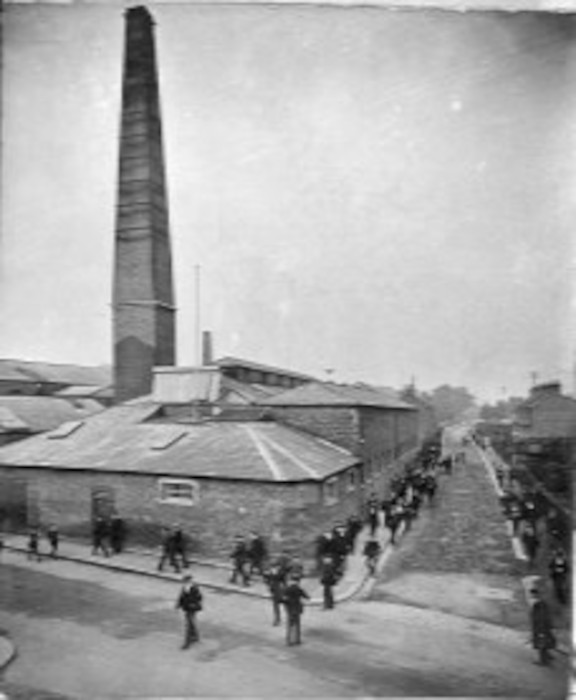
4. In 1898 the factory buildings were taken over and extended by United Flexible Metal Tubing. This view from around 1910 shows workers leaving the factory. The company initially made products for use in the gas industry. It later diversified making tubing with an internal diameter ranging from 1/8” to 24” for steam, oil, gas, hot air, hydraulics and electrical screening. [Credit: Enfield Local Studies & Archive]
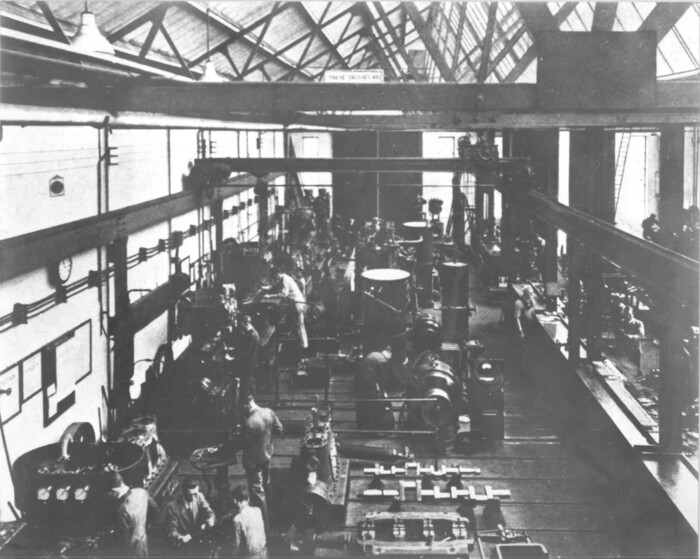
5. This view of a workshop shows the belt-driven machinery in about 1910. In 1941 the factory was struck by an aerial land mine and then damaged again by a V1 flying bomb in 1944. It was demolished in 1991. [Credit: Enfield Local Studies & Archive]
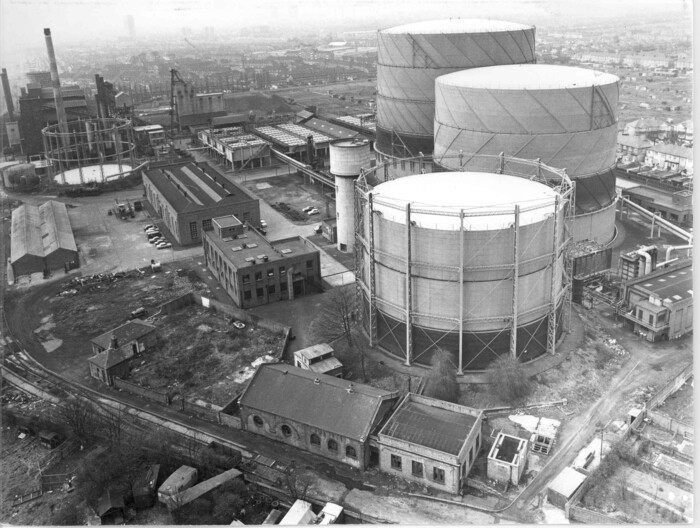
6. Ponders End and Enfield Highway Gas Company was formed in 1859. The works, at the eastern end of South Street, were built in 1860 and extended in 1882. The company merged with Enfield Gas Company in 1879 and was taken over by Tottenham and District Gas Company in 1914. This photograph shows the works being reconstructed after the Second World War. The company was nationalised in 1948. By 1972 Enfield had been converted from coal gas to North Sea natural gas and manufacture had ceased, although gas continued to be stored there. Oasis Hadley School is now on the site. [Credit: Enfield Local Studies & Archive]
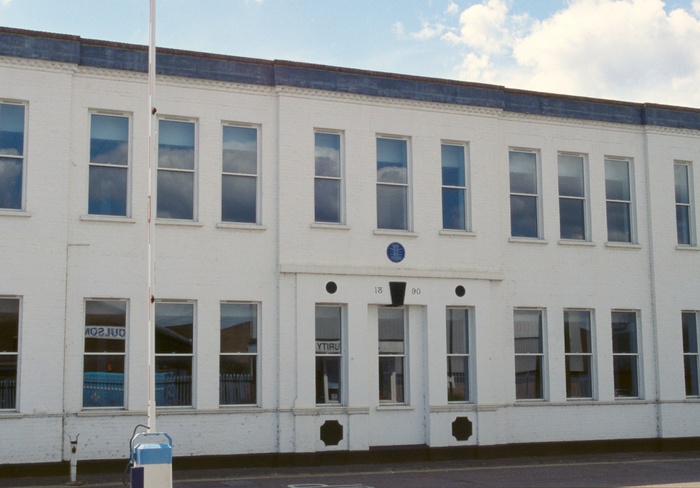
7. In 1886 a former jute factory in Duck Lees Lane was taken over by the Edison Swan United Electric Light Company (Ediswan) for the manufacture of Sir Joseph Swan’s (1828-1914) incandescent electric light bulbs. Sir James Dewar (1842-1923) invented the vacuum flask at Ediswan. In 1904 Professor Sir Ambrose Fleming (1849-1945) invented the thermionic diode valve, which marked the beginning of the electronic technological revolution. Britain’s first radio valve and television cathode ray tube factories were opened at Ediswan in 1916 and 1936 respectively.
The company became part of Thorn- EMI in 1961. The Ponders End factory closed in 1969. The only remaining building is the former Ediswan general office block of 1890, which has a plaque commemorating Swan, Dewar and Fleming. Following redevelopment, only the central part was retained, when it became the entrance to the Beavertown Brewery. (See newsletter 176 Winter 2009). [Credit: Stephen Gilburt]
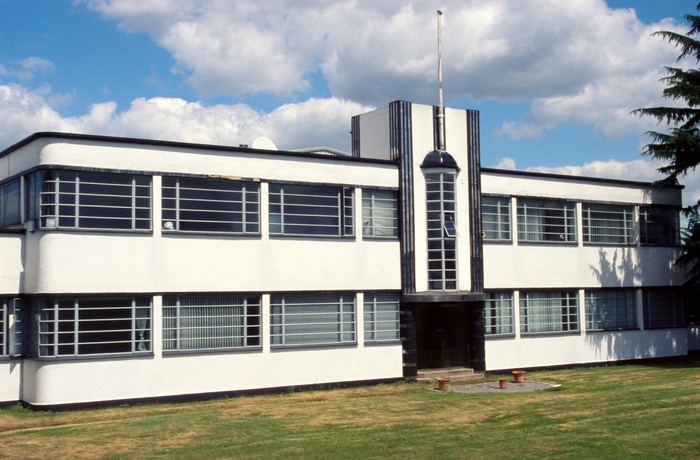
8. Following the construction of the Great Cambridge Road after the First World War, a number of light industry factories were built in the Art Deco style. One of the few buildings remaining is the Grade II listed former Ripaults factory in Southbury Road. Designed by A.H. Durnford, it opened in 1936. The factory manufactured electric cables, automotive equipment and accessories. [Credit: Stephen Gilburt]
For more information see the publications listed in the Heritage Article on Ponders End and:
Industries of Enfield (which describes 89 companies in the former Enfield Urban District) by Enfield District Manufacturers Association 1947.
Industrial Archaeology in Enfield by Enfield Archaeological Society 1971.
Enfield’s Forgotten Street, South Street Ponders End by Gary Boudier 1999.
History of Enfield by David Pam Enfield Preservation Society 3 vols 1990-1994