The Society supports a number of Groups in the Borough who enhance our railway stations keeping them looking colourfull and welcoming places.
Palmers Green
Article by Steve Moore.
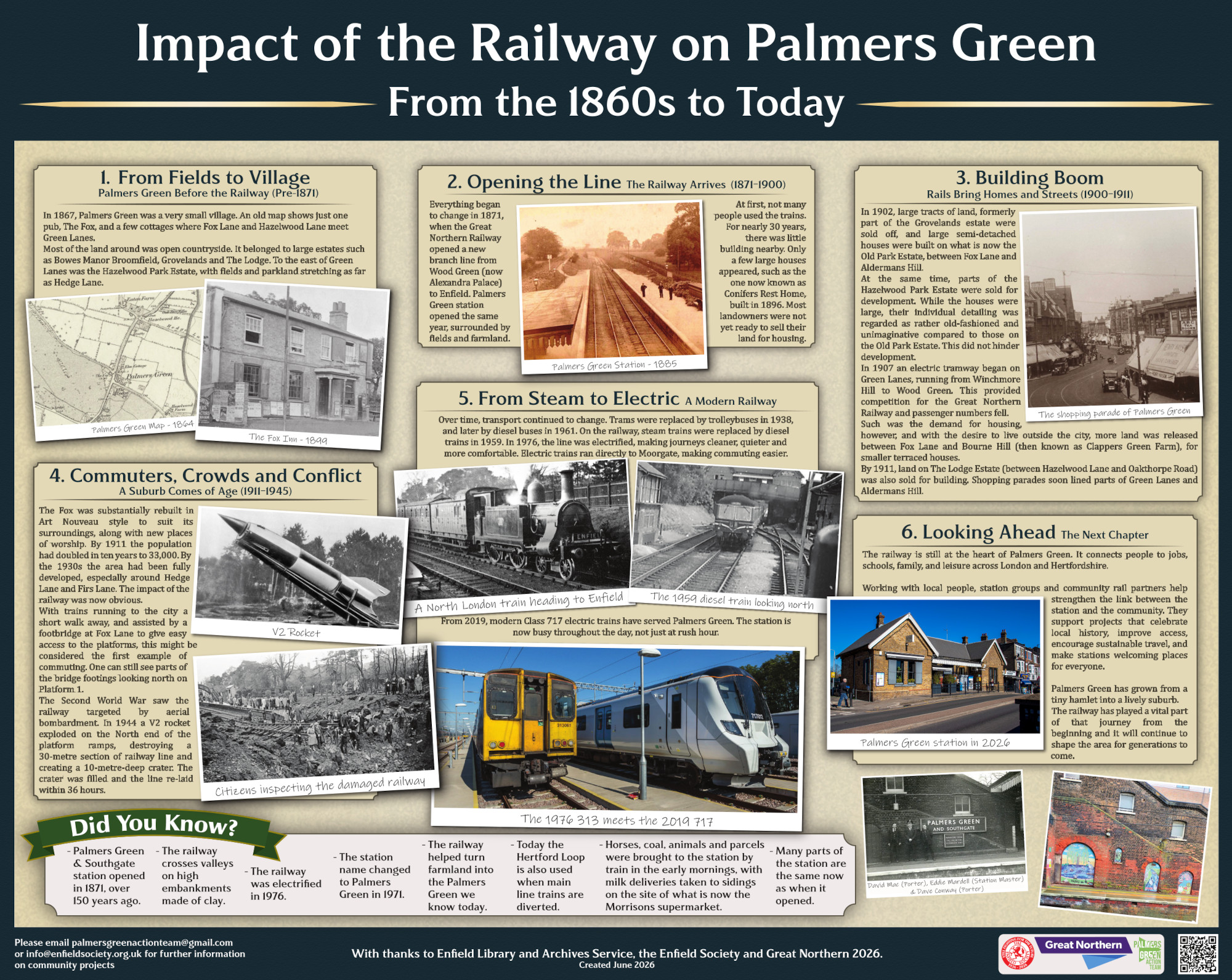
It is hard to imagine how Palmers Green appeared prior to the opening of the railway line (what we now call “the Hertford Loop”) in 1871. For the most part the area was either large estates (Broomfield, Grovelands) owned by a few wealthy individuals or farmland. It is also equally hard to imagine how long it would have remained in that state if the railway had never come through the area. The relentless development and encroachment of urbanisation that swamped most of North London in the early part of the last century could only be held back for so long. It is irrelevant of course: the railway did come and it is from the 1870’s onwards that the area grew, developed and became a much sought after residential centre with a focus on community and commuting.
To gain a detailed understanding (at least leading up to the 1980’s) seek a copy of Alan Dumayne’s book “Once Upon a Time in Palmers Green”. His thorough and detailed account is a treasure trove of information. The purpose of this article though is to give a broad understanding of how Palmers Green changed from starting off as a small hamlet to becoming a village by the late 1800’s, and then the relentless pace of development that resulted from the early 1900’s once train travel became established and goods and produce could be moved about the country easily. We should, at the same time, applaud those that encourage present day community spirit. It was a feature of the original village and today can be seen in the variety of ethnic-derived shops and a pan-European selection of forty or so different cafes and restaurants along Green Lanes alone. Locally, Palmers Green Action Team, Anthony Webb Estate Agents (for their regular “Palmers Green and Southgate Life” journal), The Enfield Society and Southgate voice and of course the railway station and staff all contribute.
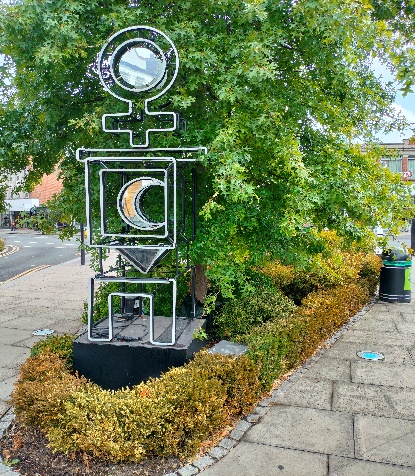
In the 21st century the hum of humanity is all around us. Buses, cars, bikes, commuters, school children (going and returning from school) commuters, day trippers and shoppers centre on Green Lanes and towards The Triangle with the railway station a short distance from there. It is busy from early morning till late in the day. The art-piece (a monument) on The Triangle (below) was installed in 2018 as recognition of the role Emily Pankhurst’s brother, Mr. Goulden, played in promoting the suffragette movement. His ‘presentations’ at the triangle did not go down well in 1914, but today we celebrate the outcome even if only a few understand what the illuminated art piece is about!
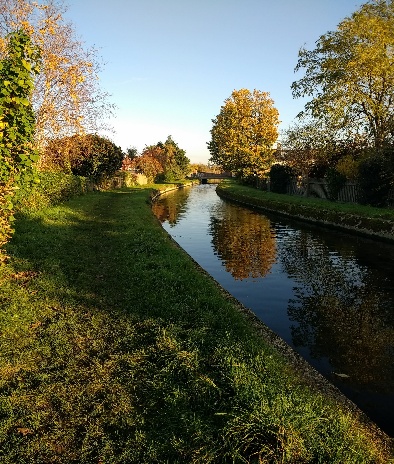
Before turning to the railway station take a moment to reflect on what Green Lanes would have been like prior to the 1870s. From way back in time (around the 1500’s) It was literally that: a tree-lined dirt lane that drovers used to take cattle, sheep and pigs to market (sometimes as far as Smithfield in the City). To the east of Green Lanes lay farmland that extended south as far as the North Circular Road (which didn’t exist until the 1920’s), east to the A10 (the border with Edmonton) , and north as far as one can imagine. This is reflected in the course of New River (neither new nor a river) which brought fresh drinking water from Hertfordshire down to Islington and the outskirts of the City. [Pictured below] It is encouraging that Thames Water now allows access along many parts of New River for walkers and, although not continuous, it is possible to get to Enfield Town from Palmers Green along a footpath that has many attractions. Local community groups such as Palmers Green Action Team today have worked to add greenery to Green Lanes and maintain many sites to make the area more pleasant.
Back in the pre-urbanised age and heading north, the area west of Green Lanes and bordered by Bourne Hill consisted mainly of large estates owned by a few wealthy individuals. Those landowners did not want to sell when the railway was proposed. They held out for a long time but eventually gave way to allow construction of the line.
Initially, Palmers Green village as was, had few houses and little demand for a railway. That changed of course from 1871 onwards when it was realised how produce from the local farms could be transported to distant markets. The railway also brought essential goods such as coal and food items to the area. Most stations had a goods yard as coal, especially, was an essential commodity that every home and business needed. The goods yard at Palmers Green was constructed where a supermarket now stands. Before long residents started to journey into London. The act of “commuting” didn’t really catch on until the turn of the twentieth century. By the turn of the century the landowners were under pressure to release the extensive sites they owned, and one by one named estate-land became known as “named housing estate”. The Great Sale of 1902 saw the Taylor estate of over 600 acres be sold off to developers. Lot number 1 was ‘Old Park Estate’ of around 130 acres. Old Park Road and Ulleswater Road were the first to be developed with a 4-bedroom house costing £450 in 1905. The 1920’s and 30’s were a period of extensive house building, and this is reflected in the style of housing.
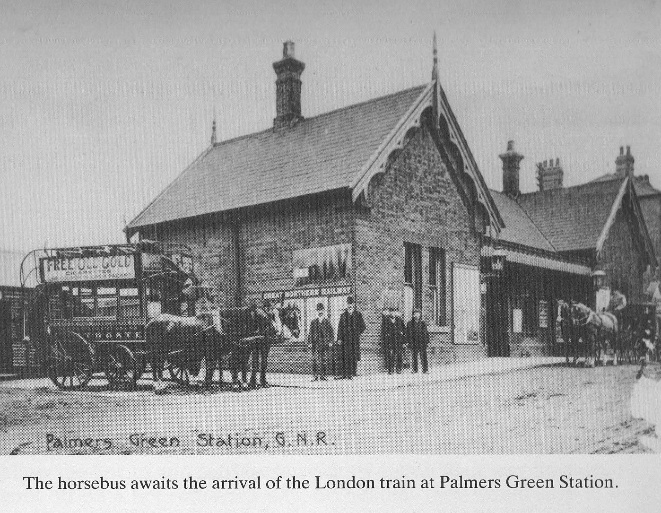
Once the railway had arrived and more housing had been built it was realised passengers needed transport to and from the station. Enter the horsebus; an open-decked cart drawn by a horse. These were the first examples of how an integrated transport policy might work (it was more about making money than a transport policy as the horsebuses were operated by local inn landlords). They were at least integrated though: the ‘bus’ would wait outside the railway station in a cobble-stone yard (where the job centre now stands) to meet up with incoming trains. Passengers were then able to use this ‘bus’ to complete their onward journey. Compare that to the timing of today’s W6 whose east-bound service is guaranteed to be sailing past the station entrance as one passes though the ticket barriers.
Farmland eventually gave way to more housing and in the 1920s and 1930s large areas were built on: Huxley Farm and Clappers Green Farm being but two of the most notable.
The town of Palmers Green was largely developed and complete by the outbreak of World War 2. Although targeted occasionally from aerial bombardment the railway served the area well. Additionally, the station buildings offered organising accommodation to the ARP (Air Raid Precautions); the entrance to which can still be found on Platform 1. Today, the station is used by approximately 29950 passengers per week, beating Winchmore Hill by around 3000 passengers per week. Weekends at Palmers Green may be less busy but there are still plenty of day trippers using the Moorgate-bound service to access London Underground, the Overground and Thameslink services. It would not be possible to imagine Palmers Green without a railway and the impact of such will continue to grow as curbs on using personal motorised transport increase in attempts to reduce climate warming and congestion on local roads.
Acknowledgements:
Once upon a time in Palmers Green by Alan Dumayne, 1988.
Station history board (to be installed)